I know this is late, but the forecast is to be near freezing tonight. IF your plants are still viable then the best course of action is to cover it with a sheet or if possible put it in a shelter. the rest of the week should not be a problem, but tonight 12-25-16 at approximately 4 am it is possible that the air temp will be at 32°. About a year ago this occurred on 1-1-16 and none of my peppers or tomato survived.
So if you are building bike's or sticking stuff under the tree, take a moment to put a sheet, that is all that should be necessary over your plants and they should be fine.
Merry Christmas and garden on! (beevis riff)
weather underground
Saturday, December 24, 2016

Thursday, December 8, 2016
Pills & Peppers
I don't know how old people do it. There is the once a day pill, the twice a day pill, the 3 times weekly except saturdays that are an odd date pills. Its astounding anyone lives beyond 30.
Tomorrow, I'll be roasting and canning 80 pounds of jalapeño. I will try to make a video of the process that is enjoyable and informative. Tonight the kitchen gets a top-down major scrub of every surface in prep for the canning.
This forms the basis of my salsa. My salsa has no tomato, onion or anything other than peppers. The jalapeño are purchased at deep discount, usually 3 pounds for a dollar, roasted and canned. Then in the coming summer, as the hot peppers fruit up and there is just a few of them, after picking, they are roasted or boiled in some water and added to the base.
Pepper aficionados that have had the salsa prepared this way love it. The un-initiated tend to fear anything I make afterwards. No gotcha's coming from my kitchen, but it seems my tolerance is pretty high and I don't notice the burn. The salsa is built for flavor and heat.
When I need salsa and there are no ripe fruit, Im not above heading to the local market and getting some habs to add to the base, but even a serrano from the garden is more flavorful than those.
There will be a fire tomorrow in SanBerdu and it will be my roaster! For now, back to the cleaning.
Sunday, July 3, 2016
Tomato Hornworms - Don't Kill them
Tomato and Tobacco Hornworms

While these insects appear to be menacing and even dangerous, they are easily controlled and they provide an important role in your garden. Don't kill them! (yet)
Do I have them?
The first clue they are present was back in the late fall, when you dug up last years garden or stirred your compost pile and saw them in their equally menacing pupae stage. They look similar and are approximately the same size and the Japanese Beatle (a devastating pest) that will appearing later in the summer.You might have noticed the egg of the worm in February when it appeared on the underside of a nightshade (yep, tomato and peppers kids) as a small white or light green egg about the size ball point tip.
The Beetle is easily controlled with the neem oil you have already been spraying. Hornworms LOL at your puny neem oil.
Worm Control
Equally, hornworms also scoff at your meager attempts to control with baking soda, epsom salt, diatomaceous earth, or soap. These fail equally and that is a good thing. Worms in this category are important hosts for a parasitoid wasp. These wasps infect and deliciously consume the worm. Then the wasps go on to find other hornworms. Win win! (spoiler at end of this page)Revenge!
Right now this moth is in the worm stage of its life cycle. This is where we get our revenge!
If your hornworm has these rice like attachments it has been infected with a parasitic wasp. It is very unlikely that you will ever see this wasp, as they are very small. An infected worm should be valued and coveted. You should capture the worm on the stem (by cutting the stem near the worm) and drop the stem and the worm into a jar or bucket. Then give it a few leaves to eat. (crazy right?) For your efforts, the worm will be food.
Its death (consumption) will be a benefit to your garden as it controls other hornworms, and its satisfyingly gruesome.
In the End
Your garden is a place of life. All sorts of battles occur when you sleep, work, or garden. Some are within your control and some not. Wisdom is knowing the difference. Only You can make that determination. The Tomato Hornworm is a food source. It is part of the circle of life and all that. Like the aphid I wrote about it is a part of the whole equilibrium of life.
Spoiler
If preserving the ugly scary worm for a small wasp to eat is not your bag, I can dig that. For 100% control of hornworms and all other worms from getting on your plants, you want Bacillus thuringiensis, commonly known as 'bt'. Bt can be found at your local garden center as Thuringiensis or Green Garden dust etc. Check the ingredients of the product.
attribution
http://extension.colostate.edu/topic-areas/insects/hornworms-and-hummingbird-moths-5-517/
http://www.harvesttotable.com/wp-content/uploads/2012/06/Parasitic-wasp-eggs-on-hornworm1.jpg
Wednesday, June 15, 2016
It's About to Get HOT!
Weather this is accurate or not, its going to be hot for the next couple of weeks. What should you do to help your plants? (like my little play on words)

What to Do?
In our area the biggest concern while there is heat wave is the addition of wind. A Santa Ana event associated with a heat wave can be devastating to your food producing plants. The addition of wind makes using shade cloth more difficult. Further it dries out vegetation quicker than the plant can hydrate its leaves. A 12 mph wind in urban San Berdu should not be a concern.
Mulch! and mulch again!!
This time of year is why you mulch 5 inches. A natural wooden mulch will help the plant deal with the heat. When the container becomes warm the water in the soil medium will evaporate into the mulch. The extra edges of the mulch allows the water to cool and return to the soil. This is a breathing soil. It is good! Top your containers off with mulch. It is important that you do NOT soak your mulch. You want your mulch to be dry when this heat event starts so the aspiration occurs. A wet mulch will not allow the water in the soil to evaporate. Also in the heat it will heat up and now you have hot water surounding your plant. That would be bad.
Home as Shade
Using structural shade and wind protection is easy and efficient. Move your potted plants to the north side of the house or very close to a solid fence.
Daily Observation
Check your plants for wilt daily. If you do the things in this post and your plant still seems stressed, it might be worth it to bring it inside the garage or other structure. Since most insects are carried into the home by humans, I would discourage bringing your plants into the home. Even a diligent inspector may miss some bug and I would feel bad if you brought something into your home that is much worse than the plant having died.
Watering
Water before sun is on your plants or after it is off.
Since we don't over water already (right?) hydrating the growth medium with no fertilizer will provide the plant with the water it needs when it needs it. Ward against allowing soil medium heating up. One year the soil temperature was 106°. Obviously the plant did not survive. What I did wrongly then was soak the mulch. To water move the mulch to the side and apply water slowly and deeply to the surface of the soil.
Know When to say 'I learned Something'
If your plant completely wilts in the first day, its already too late. Try to save it, and learn from your efforts. When you finally resolve that its done, check the soil. Try to take the plant from the container by sliding out the soil and plant together. Then try to remove one side of the soil from top to bottom. You want to observe a cut-away of your soil and roots. Take note: is it too wet? Are the roots very short from the stem? What is living in the soil? Is the bottom dry or wet? Why? What is the temperature of the soil, does it feel warm/hot?
What to Buy?
Shade Cloth (burlap)
If you must buy something to provide shade, 3 ft. x 100 ft. Burlap at homedepot is $40.00. Also clothes pins are $3.00. Put the burlap on a fence secured by the clothespins will create a nice shade that was not there before. The burlap can also be draped between things to provide shade. the burlap is kind of cheap and can be re-used, we know it will be hot again.Here Kitty, Kitty, Kitty
Although the internet says to use kitty litter mixed in with soil or soil medium in about the same ratio as perlite will serve as mystical little water holders. While this would work during a transplant, it does not do much for heat/wind.
If you apply this to the top of your container, the clay part of the litter will form a solid and then heat up. This would be bad.
This could be Significant
The temp going down to 70° degrees overnight and the humidity hanging around 30% will help. I am not predicting plant loss, however I hope your plants and mine survive this week. I am going to spend my saturday preparing my existing plants and planning for the future by starting new plants. The best that could happen would be ripened tomato and hotter chilis.
Monday, May 30, 2016
Prevention
Hope is Not a Plan
An ounce of prevention is worth a pound of cure.
My normal preventative treatment for tomato and chili plants (since they are both nightshade) is not organic. Im really not liking the use of that term. It has been taken over by the snake oil salesmen of the world to take money from your pocket. </end rant>
I have decided to add a new ingredient to my normal twice a month preventative spray. Here's the old recipe:
1 gallon water
1 table spoon baking soda
1 500mg aspirin
total cost; $0.23 if that.
to that I have added
2 table spoon DE (diatomaceous earth) (add $0.03)
These folks seems to be pretty well up on what the baking soda does:
and these folks seem credible (from University of Arizona) on aspirin
and these folks are just hog crazy about DE
I wanted to test to see if the DE would clog my sprayer (it did not) and also to see if I could detect it on the plant surface after it had dried.
I did this in a side by side test. One plant was treated with the original recipe and one with extra crispy. (and now the reason there is no photo in this post)
Since the baking soda dries on the leaf with a white residue and the DE dries with a white residue, the only way I could think of was to taste it. I was successful in tasting the DE from a moistening finger swab of the 2 leafs. (with a palette cleansing cracker between). So just trust me.
After 1 week there have been no detrimental effects on either plant.
So for about $0.26 cents I have the most effective preventative spray to guard against:
early blight, late blight, aphids, horned tomato worm, chili wilt, etc etc etc.
Hows that for Organic?
Friday, May 27, 2016
homedepot sale item
found thing at home depot
this item:
http://www.highcountrygardens.com/butterfly-and-hummingbird-wildflower-seed-mix
cover 500 sq ft.
$7.98 at
San Bernardino #683 highland near 215
this item:
http://www.highcountrygardens.com/butterfly-and-hummingbird-wildflower-seed-mix
cover 500 sq ft.
$7.98 at
San Bernardino #683 highland near 215
not listed on hd website. gonna over seed my 4x4 raised.


Monday, May 23, 2016


Saturday, May 21, 2016
Suckers Progress (1st stage)
I hand snapped these suckers from a couple tomatos in the back. Put them in a weak micrlgro solution. I changed water in 1 week. Light was incidental inside light. Took pictures.
Less than 2 weeks later, I think there is enough root material to transplant into medium (peet/perlite).
Today they are going into double cups.
5.09.16

5.10.16

5.13.16

5.21.16

this is not a stronger solution, its just different lighting.
05.21.16

Stay tuned for transplant progress.
Saturday, May 14, 2016
Blossom End Rot
The reasons for Blossom End Rot
The most common is too much fertilizer causes the plant to grow so fast that the calcium can’t move into the plant quickly enough.The other reason is there is not enough calcium present in a usable form in the soil/medium.
Calcium is slow uptake all by its self. The calcium available to plants must be present and changed into usable form prior to the plants need to use it.
Epsom Salt and Tums
Im no chemist, but I think that the sulphate in the epsom salt facilitates (not speeds up) the availability of calcium and other nutrients to be used by the plant and magnesium improves soil quality by providing a hospitable place for bacteria/grubs/etc.Calcium carbonate in the form of tums should be applied at transplant. Most ground pounders (soil gardeners) apply the finely ground (in a blender, makes it easy) in the hole when the plant is transferred into from another pot/ground etc. The thinking is that by the time the plant needs it, it has broken down into a usable form.
Monday, May 9, 2016
hilled potato, Thank you Patrick.
The fourth or fifth photo down is probably the best to evaluate.
Before the hilling, all the growth was lush, green and upright. Then I hilled the potato with normal mature soil and seemingly all the growth fell over, got yellow and eventually brown.
The white powder is of zero concern. It is diatomaceous earth and was applied a week subsequent to the above conditions.
The white powder is of zero concern. It is diatomaceous earth and was applied a week subsequent to the above conditions.


Friday, May 6, 2016
The Hard Paradigm of an Advanced Gardener
Aphids - Can't live with 'em, Can't live without 'em!
Honesty First and Last
I completely jacked this article from HERE and they completely deserve your click. It is very well researched and sourced. I cleaned it up a bit and then added my experience.
Remove what you can, don't kill everything you see:
After doing week of research myself, I am recommending to you, when you encounter aphids on your plants, first step it to accurately identify that is what you have. This is a link to a UC Davis document shows photos of different aphid species. Secondly, remove what you can of the infested leaves and stems and discard more than 5 feet away from any plants you do not want infected. Ya know that noisy neighbor whos dog always leaves you a gift between your front door and car. He would love some aphid infected 'clippings' for his garden. The main point of this is, by removing what you can, and not killing what you see, you enhance the beneficials life cycle. And you might make a friend, although doubtful.
- Plants can survive an aphid attack without you. If you see a few aphids your plant is not doomed. Healthy crops can fight off the damage. There are beneficials that thrive on aphids. Lacewings, syrphid flies and lady beetles have babies and those larvae love to nurse on aphids. Larvae consume 20 aphids a day. Grown lady beetle can eat more than 50!
- Most aphids can’t fly and are terrible climbers. The majority of aphids in a colony do not have wings. The wingless spend their entire life cycle basically in place. If they get knocked off they won’t be able to get back to the plant. If you use a strong spray of water and send them to the ground, they will most likely starve to death. A small percentage of the aphid population will grow wings. The force of the stream of water will damage them too.
- Releasing lady beetles near an infestation will not work. Lady beetles, aka “lady bugs” are your friends in the garden but they are not Seal Team Six. Studies show that the natural predators in a garden have a hard time catching up to the growth of aphids. If you’re going to take a chance on store-packaged lady bugs, first water the garden at dusk and then let go of the batch.
- All aphids are capable of carrying plant viruses. It takes one infected aphid to make a plant sick. The virus stunts growth and hinders flower and fruit production. Instead of trying to kill every aphid, a more realistic approach is to weigh the damage and the risks involved in keeping the aphid around. Certain crops like squash, cucumbers, pumpkins, melons, beans, potatoes, lettuce, beets, chard and bok choy are more prone to aphid viruses. A decision needs to be made if the plant shows severe signs of damage. It might be best to destroy the plant. Some real advanced gardeners keep a few plants around that expected to be infested and then control or eliminate on other sensitive plants. What brilliance huh?
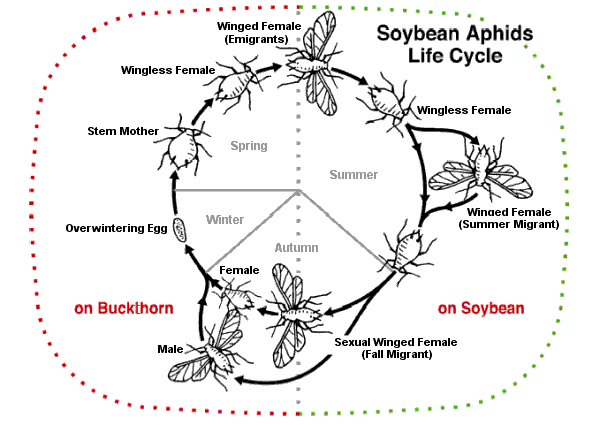
- Prevention is not always the best medicine. Another important tip to consider is that early spraying of natural or synthetic chemicals to ward off aphid attacks might actually encourage aphid outbreaks because natural predators are killed off before they’re needed the most. The life cycles go like this: predators eggs are laid. Aphid larvae are laid. Predators are born and seek food. In a perfect world, most of the aphids are eaten, leaving some to live on and propogate to feed the next generation of predator.
- There is an aphid season. Many species of aphids cause the greatest damage in late spring when temperatures are warm but not hot (65°-80°F). One aphid can produce a hundred or more aphids in 4 weeks. The are most active in from now thru July. In colder months they might still be around lurking in perennial bushes or weeds. Once I learned this I looked closer at my shrubs and sure enough I spotted aphids in the shaded, overgrown areas.
- If ants are present, your aphids have survival insurance. Ants and aphids act like a team. The aphids get protection from predators and the ants gather the honeydew produced by the aphids. Ants stimulate or tickle the bellies of aphids to get them to excrete the sweet treat. The honeydew that is being farmed by the ants might mold on your plant and this is the black sooty fungus you see near aphid colonies. The mold does not do as much damage. Studies show that ants not only protect the aphids from ladybugs, parasitic wasps and lacewings, but they also make it possible to have bigger and longer lasting colonies with higher reproduction rates. Control ants.
- Counting aphids could put you to sleep. Farmers conduct sampling to determine if insecticides are needed to treat aphid infestations. The home gardener can use the same approach to identify the mildest and most effective method of pest control. The University of Minnesota Entomology Department created a worksheet for “speed scouting” for aphids on soybean crops. If a plant has less than 40 aphids it was considered not to be infested. In your garden, you may want to use a similar approach. You can always check again in 3-5 days to see if numbers are increasing. If they are not increasing and your plants are healthy, it’s better to let nature take its course. If you worry too much and insist on doing something, water and milk have been reported to reduce aphid populations by dislodging and suffocating them.

- Natural, organic and homemade deterrents and pesticides can harm beneficial insects. Insecticidal soaps kill soft bodied insects by drying out the skin of an insect. However, since the larvae of the lacewing, syrpid fly and lady beetle are soft bodied, these treatments affect our friends in the garden. Pepper spray and the capsaicin in it, is toxic and lethal to honey bees. Garlic, pepper and onions plants are natural repellents to aphids. Although neem oil and horticultural oils are options that can kill beneficial insects alongside the aphids, these oils won’t kill new insects that fly in after the application.
- The Best Natural Killer of Aphids: Water that knocks them off the plants and milk that protects leaves from infection are the cheapest, most effective methods. Maybe it seems too good to be true but knowing what we know now, it makes sense. Water can be used from a hose or spray bottle with just enough pressure to dislodge the insect, sending it to the ground. Aphids, as stated above, are not strong enough to find their way back. Another option is milk. Leaves coated with a milk spray may be less vulnerable to damage and the transmission of aphid-borne viruses. These recommendations are less about preventing an aphid infestation and more about addressing an existing outbreak. A strong water spray or milk application may be just enough to set your garden back on track.
Examine the life cycle of all involved. If plant virus delivered from an aphid killed every plant, thus reducing the food source for the aphid, it kills its self off. Nature does not do that.

If lady bugs ate all the aphids, the lady bugs would have more difficulty finding food, thus eating themselves to death. Nature does not do that.
Warning: predictable Dogma approaching; Only humans do what nature does not.
Thursday, April 28, 2016
Trip Around the Garden
In other words, Showin Off!
Here is the group that went outside at the first of April or there about. Ill top the mulch on these over the weekend. When rain is in the forecast I broadcast about a tablespoon of 10-10-10 on the mulch, trying to ensure there are none of those hard balls touching the stem. Also since there is rain forecast for tonight/tomorrow, no DE, but a shower of DE will return on saturday.
(not) Watering
These have not been watered. Since the inside container was placed into the outer container I have not watered these plants. Granted there has been some rain in the land below the Arrow, but thats about a month of no watering at all. (this is san bernardino, CA alleged drought capitol of the world)

Hey! Is that a Blue Weed?!
or I knew there was a secret.
The blue curly thing is something I bought a couple years ago and got it on such a deep discount (I think about $2) that I decided to grow tomato's. I dont particularly like tomato and I dont put them in my salsa but I had these things that needed to be used.

I don't recall what the name of the curly thing is, but it has one use. That being, to grow single stem tomato's on. Oh, here's a yellow one. To be honest they don't work as well in the container, but soon the wobbliness of the curly thing will be taken over by the great strength of the stem of the tomato.


Some trimming to be done
As these stalks are growing up, I will be grooming the tomato to be not only single stem but blight resistant (by removing the lower 8 to 10 inches of branches) and weaving the stalk through the curly thing. (which from now on I'm going to call a stalk minder) I have been keeping a nearly daily watch for suckers and removing them with extreme prejudice.


Chili's
I dont know what this is, its not important at this point. It is a chili. It is a hot chili. It is green and growing well. I am happy.
In the cups, a couple deaths. I think they were tomato's and I have enough, so no loss. These cups have been harmfully tossed and left on a table for the last week or so. A kind of tough love called hardening off, more like trial by fire. Into the buckets this weekend!

Other Stuff
These were planted from a garlic I bought at the super market (which is not so super), broke apart and put in the raised bed. I saw or read somewhere that if you cut the leaves of garlic and onion that your fruit is larger. About once a week I cut every leaf that has bent. Stay Tuned.
This particular bed was created from cardboard boxes (beer, beans, pizza etc consumer boxes), leaves from work, grass clippings that contained a scary amount of dried pine needles (rumored to screw up the Ph of anything within a hundred miles). This ~4'x4' raised bed got the worst of it. There was school trash, and small plastic bags in with the leaves. Shiny sided boxes with lots of (eek!) harmful (not) ink and gloss (which is likely wax). I fear NOT. Into the breech. Started in late summer. The grass on top was added subsequent to garlic sprouting and was completely dry when applied.

Last but not Least, Failure
I am fortunate to have a couple ducats to rub together to feed myself. If I relied on my expertise in growing potato I would probably would have expired by now. I think this is my fault. I added some immature compost, so immature that it still had a bit of heat (I discovered after applying) deeper down in the compost container. I think that active composting nuked my other wise good looking potato plants. I think I got these from Sandy. They are a purple variety (can't ya tell). For now these will go into the root cellar (which no one in San Bernardino has) and wait for the fall to be planted again. The photo is of the results of one potato that was cut into 2 pieces. It was small to begin with.
04.28.16
04.28.16
Tuesday, April 26, 2016
What is this magic stuff called, Water?
Tip of the Week: 04.26.16
According to Wired Magazine:
Watering isn’t easy. “The single biggest human cause of plant death is overwatering or incorrect watering,” says Mike McGrath, expert gardener and host of the nationally syndicated public radio show You Bet Your Garden. “If you water a plant all the time its roots won’t grow because roots only grow in search of water.”
Careful daily examination of your plants and a bit of guilt for killing plants will gain you the experience to determine over/under watering. Almost all gardeners overwater. Yes, you do. You might not be a plant killer, but your plant needs so much less water than is provided it by the home gardener to survive.
We do want more than survival. We want phatt colorful fruits all over the place, so our bad over watering is reinforced. The key is when overwatering is beneficial and when it is terminal.
Now it not the time to overwater.
Monday, April 11, 2016
Before and After a Rain
After a rain...
- Apply diatomaceous earth to plants
- ensure you plants are not sitting in water
Before a rain...
- apply long acting fertilizer
- try to ensure no leaves are touching ground
- you don't want the leaves to touch standing or still water
please post in comment section on what I am forgetting.
Benefits of Mulch
Mulching Your Container Garden
Why Mulch? What is Mulch?
Mulch is a term used to describe a material that protects the soil surface and the plant. Mulch also allows the exchange of water and air from the soil to the environment.
In our case, mulch allows your soil to breath while protecting it from extreme heat and assists in the protection of plants from blight. Here is a link about Blight from Purdue University. If you grow tomatoes, you should be very well versed on this document.
I recommend 5 inches of mulch for tomatoes and chilis in San Bernardino.
In our case, mulch allows your soil to breath while protecting it from extreme heat and assists in the protection of plants from blight. Here is a link about Blight from Purdue University. If you grow tomatoes, you should be very well versed on this document.
I recommend 5 inches of mulch for tomatoes and chilis in San Bernardino.
That is actually enough, right there.
Sunday, April 10, 2016
UPDATE 041016
Out door plants (so far)
I travelled to vegas yesterday. It snowed, but a great time was had by all. Vegas trip at bottom of page.
These are the tomato the chili that went outside a couple weeks ago. The tomato shows a bit of damage from yesterday's rain, but certainly not a terminal amount. The white is the diatomaceous earth (DE) getting wet and then drying on the leaf. No worries there either.

This is a Fatalii (link) to time lapse.
(Note the leaves while sun is on. Most all chili's do this)

This is likely a spanish hab

A bit of damage on the main step. This might be fatal.
If I can not train this for a single stem, it will meet its demise by my hand.
muwhaahaaa!


Vegas Snow!
and then just a couple mins later...
Thursday, April 7, 2016
Right Now!
This week in San Bernardino
Its a great week to harden off your plants. Sun them, get them out of the house!! It is very good forecast for just taking them outside and leaving, night and day for the next 5 days. It will likely completely harden off your plants with little effort.
Monday, April 4, 2016
TOTW First of April
Tip of the Week: 04.07.16
Now that your tomato's are out in the sun, its time to start protecting against pests.
Required Materials:
- a 2 liter soda bottle and lid
- a drill bit (anything smaller than 1/4 inch)
- or a nail and hammer
- diatomaceous earth (DE)
- does not need to be food grade or other special branding
- This or that or any diatomaceous earth you feel comfortable purchasing from any source is fine. Diatomaceous earth has many uses. Some are insect related, some are ceramic ware related (I have never seen a ceramic kiln that used bricks to insulate that did not use DE bricks. Its all the same stuff. Its a specific mud that when added to water can be formed into shapes or pulverized to dust. One form kills insects.
- What is DE? Its dirt, granted a specific kind of dirt, but still dirt and just as dangerous to you regular dirt.
Preparation of Materials:
- Simply drill or poke to create 3 to 4 holes in the lid.
- Put abut 1/2 cup diatomaceous earth (DE) into the dry 2 liter bottle.
- Put the lid on the bottle
- Squeeze the bottle to atomize or dust, the DE powder onto the plants.
 |
| Inside of lid with holes |
 |
| Outside of lid with holes |
The bottle is usually/mostly horizontal. The 1/2 cup recommendation is for you to become accustomed to it. After that, put all you like. Its only $8.00 for about the amount of DE you would use in a decade.
Application:
When the plant is dry and out of direct sun (late afternoon) apply liberally by squeezing bottle to atomize the DE towards the plant. Applicator should be less than a foot away. Adjust as you become proficient.
Subscribe to:
Posts (Atom)